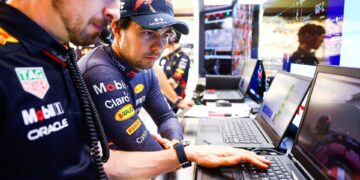
Formula One is often perceived through the lens of glamour: the Monaco harbor, the celebrity attendees, the smell of burning rubber, and the deafening roar of hybrid engines. To the casual observer, it is a sport defined by the bravery of twenty drivers and the mechanical genius of their engineers. However, beneath the carbon fiber chassis and the asphalt track lies a hidden infrastructure that has become the single most valuable asset in the sport’s multi-billion-dollar economy. This asset is not fuel, nor tires, nor even the drivers themselves. It is data, and the engine that processes it is Amazon Web Services (AWS).
In the high-stakes world of modern motorsport, the difference between a World Championship and a forgotten season is often measured in milliseconds. These milliseconds are no longer found solely by tightening a bolt or adjusting a wing angle; they are mined from petabytes of data using sophisticated cloud algorithms. The partnership between Formula One and AWS represents a seismic shift in how sports are managed, analyzed, and won. It transforms the sport into a high-velocity data science competition.
This article peels back the curtain on the “Billion-Dollar Secret.” We will explore how the world’s most dominant cloud platform powers the world’s fastest sport, from the aerodynamic simulations that design the cars to the real-time strategies that decide the race winners. For investors, tech enthusiasts, and IT leaders, this is the ultimate case study in digital transformation, high-performance computing (HPC), and the monetization of big data.
I. The Data Lake: Ingesting the Firehose of Telemetry
To understand the scale of the AWS operation within F1, one must first comprehend the sheer volume of data generated. A modern Formula One car is less of a vehicle and more of a traveling IoT (Internet of Things) laboratory.
A. The Sensor Revolution
Each F1 car is equipped with approximately 300 sensors. These are not simple GPS trackers; they are highly advanced instruments measuring tire surface temperatures, brake pressure, fuel flow rates, gravitational forces, and engine torque. A. High-Frequency Transmission: These sensors transmit data thousands of times per second. During a typical race weekend, a single team can generate terabytes of raw data. B. The Latency Challenge: The critical challenge is not just collecting this data, but transmitting it from a track in rural Brazil or the streets of Singapore to the team’s factory in the UK or Italy with near-zero latency. C. AWS Kinesis and S3: F1 relies on services like Amazon Kinesis for real-time data streaming and Amazon Simple Storage Service (S3) for constructing massive data lakes. This architecture allows engineers to ingest the “firehose” of telemetry data instantly, organizing it for immediate analysis. Without the scalability of the cloud, on-premises servers would choke under the bandwidth requirements of a Grand Prix weekend.
B. Historical Data Mining
The value of data is not limited to the present moment. AWS allows teams to store decades of historical race data—weather patterns, tire degradation rates on specific asphalts, and driver behavioral analysis. A. Pattern Recognition: By keeping petabytes of historical data in Amazon S3 Glacier (low-cost archival storage), teams can use machine learning models to cross-reference current conditions with a race from five years ago. B. Instant Retrieval: When a sudden rainstorm hits the track, the cloud allows strategists to instantly pull up every wet-weather race scenario from the last 20 years to predict how the intermediate tires will perform on the current track surface.
II. Computational Fluid Dynamics (CFD): The Virtual Wind Tunnel
Perhaps the most financially significant impact of AWS in F1 is the revolution in aerodynamics. Traditionally, teams spent fortunes building and running physical wind tunnels—massive, electricity-guzzling facilities used to test air flow over the car.
A. The Limit of Physical Testing
The FIA (Fédération Internationale de l’Automobile) strictly limits the number of hours a team can use a physical wind tunnel to ensure fair competition and reduce costs. This created a bottleneck for innovation. If you can’t test physically, you must test virtually.
B. High-Performance Computing (HPC) on AWS
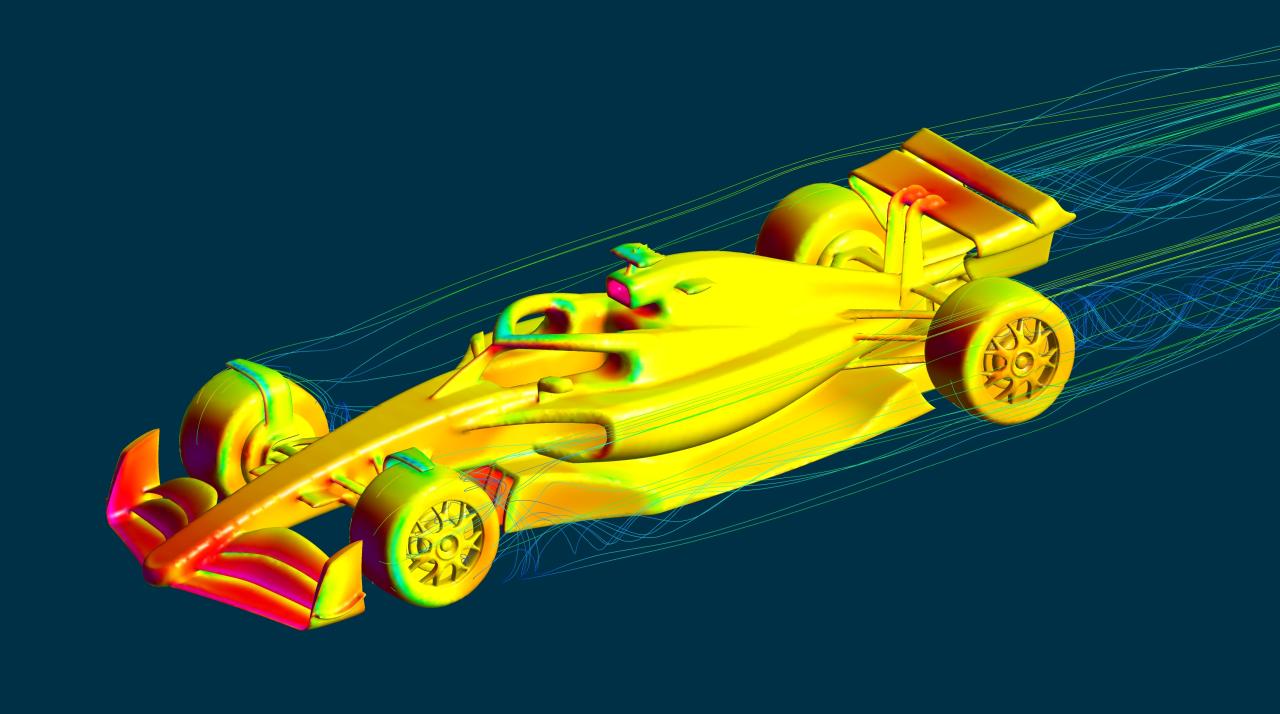
This is where Computational Fluid Dynamics (CFD) comes into play. CFD involves complex physics simulations that model how air moves around the car. A. EC2 Spot Instances: F1 teams utilize Amazon EC2 (Elastic Compute Cloud) to spin up massive clusters of high-performance computing cores. Specifically, they use “Spot Instances”—excess cloud capacity available at a steep discount—to run these simulations cost-effectively. B. The c5n Instances: F1 utilizes advanced instance types like the c5n, which offer high network bandwidth. This is crucial because CFD simulations require thousands of cores to “talk” to each other simultaneously to solve the Navier-Stokes equations (the physics of fluid motion). C. Reduced R&D Time: In the past, running a full car simulation might take days on an internal supercomputer. With AWS, teams can scale up to tens of thousands of cores instantly, reducing simulation time to hours. This allows aerodynamicists to iterate hundreds of front-wing designs in a single week, a feat impossible with physical hardware.
III. The 2022 Regulation Overhaul: A Car Born in the Cloud
The ultimate testament to AWS’s power was the 2022 F1 rules revolution. The sport needed to redesign the cars to allow for closer racing, as the previous generation of cars created too much “dirty air” (turbulence), making overtaking difficult.
A. Project “Simulation”
Formula One’s internal motorsport team, led by Ross Brawn and Pat Symonds, turned to AWS to design the blueprint for the future of the sport. They didn’t build a physical prototype until the very end; the car was born entirely in the AWS cloud.
B. The Scale of the Calculation
To ensure the new rules would work, F1 ran one of the most complex CFD projects in history. A. 1,150 Compute Cores: The project utilized over 1,150 compute cores running in parallel. B. 550 Million Data Points: The simulations generated over 550 million data points per model to analyze the wake turbulence of two cars following each other. C. Reducing the Wake: Through this massive cloud calculation, they engineered a design that reduced the loss of downforce for a following car from 50% to just 15%. This arguably saved the entertainment value of the sport, directly impacting its billion-dollar valuation and viewership growth.
IV. Race Strategy: The Monte Carlo Effect
On Sunday, the “Billion-Dollar Secret” shifts from design to real-time tactical warfare. Strategy—when to pit, what tires to fit, and how to manage fuel—is no longer a gut feeling. It is a probability game played by Amazon SageMaker.
A. Predicting the Unpredictable
Before the lights even go out, teams have run billions of simulations. A. Monte Carlo Simulations: Teams use the cloud to run Monte Carlo simulations. This is a mathematical technique where the race is run virtually millions of times with slightly different variables (e.g., a Safety Car on lap 14, a 2-second slow pit stop, a sudden drop in track temperature). B. The Probability Curve: The output is not a single answer, but a probability distribution. The AI might tell the strategist: “Strategy A has a 60% win probability but high risk; Strategy B has a 40% win probability but guarantees a podium finish.”
B. The “Undercut” Calculation
During the race, the AWS cloud recalculates these probabilities in real-time. A. The Undercut: This is a strategic move where a driver pits early to get fresh tires and drives a fast out-lap to jump ahead of a rival. AWS algorithms calculate the exact moment the “undercut window” opens. B. Traffic Modeling: The system tracks the GPS location of every car on the track. It predicts exactly where a driver will re-join the race after a pit stop, ensuring they don’t get stuck behind a slower car. This requires processing live position data and lap time deltas instantly—a task only possible with edge computing and cloud speed.
V. F1 Insights: Monetizing the Fan Experience
AWS is not just a back-end tool for teams; it is a front-end product for the commercial rights holder. F1 has used AWS to revolutionize the TV broadcast, engaging a younger, data-hungry audience. This is a direct revenue driver, increasing the value of broadcasting rights.
A. Graphic Innovation
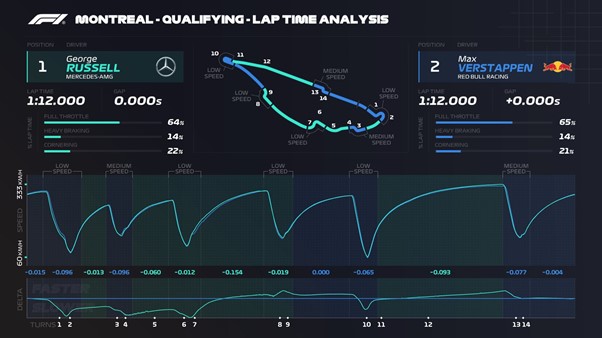
If you watch a modern F1 race, you will see “F1 Insights powered by AWS” graphics overlaid on the screen. A. Overtake Probability: Machine learning models analyze the speed difference, cornering performance, and tire life of two battling drivers to assign a percentage chance of an overtake happening. B. Car Performance Scores: AWS assigns scores to different aspects of the car (Cornering, Straight Line Speed) allowing fans to visually compare the strengths of a Red Bull versus a Ferrari. C. Tire Life Remaining: Perhaps the most controversial but fascinating stat. The AI looks at the lap time drop-off and historical degradation data to estimate how many laps of “grip” are left in the tires.
B. Deep Learning for Drama
These insights do more than inform; they create narrative. By visualizing the data, AWS helps the commentators explain the tension of a strategic battle that might be invisible to the naked eye. This deeper engagement keeps viewers glued to the screen, boosting advertising revenue and sponsorship value.
VI. FinOps and The Cost Cap: Efficiency as a Competitive Advantage
In 2021, Formula One introduced a strict budget cap (approx. $135 million per season). This changed the financial landscape of the sport. Teams could no longer solve problems by throwing money at them. They had to be efficient.
A. The Move from CapEx to OpEx
Traditional IT infrastructure requires huge Capital Expenditure (CapEx)—buying servers, cooling systems, and building data centers. This counts heavily against the budget. A. Operational Expenditure: Cloud computing shifts this to Operational Expenditure (OpEx). Teams only pay for the seconds of compute time they use. B. Eliminating Waste: With AWS, teams can spin up 10,000 cores for a massive simulation on Tuesday, and shut them all down on Wednesday. They don’t pay for idle servers. This “pay-as-you-go” model is critical for staying under the cost cap while maximizing performance.
B. Sustainable Computing
F1 has pledged to be Net Zero Carbon by 2030. AWS plays a crucial role here. A. Server Efficiency: Cloud providers run data centers at a much higher efficiency (PUE) than on-premise team factories. B. Remote Operations: By moving data processing to the cloud, teams send fewer IT staff and less hardware to the race tracks, reducing the logistical carbon footprint of air freighting tonnes of servers around the world.
VII. Security: Guarding the Intellectual Property
In a sport where espionage has a long history and a photo of a car’s floor can reveal million-dollar aerodynamic secrets, data security is paramount.
A. Encryption and Access Control
The designs of the cars and the strategy algorithms are the teams’ most valuable Intellectual Property (IP). A. VPC (Virtual Private Cloud): Teams utilize Amazon VPC to create isolated, secure networks within the cloud that are inaccessible to the public or rivals. B. Encryption at Rest and in Transit: Data is encrypted using AWS Key Management Service (KMS). Whether the data is sitting in an S3 bucket or flying across the fiber optic cables from the track, it is unreadable to anyone without the cryptographic keys.
B. Threat Detection
With the high profile of F1 teams, they are constant targets for cyberattacks. A. Amazon GuardDuty: Teams employ intelligent threat detection services like GuardDuty to continuously monitor their cloud accounts for malicious activity or unauthorized access attempts.
Conclusion
The narrative of Formula One has shifted. It is no longer just about the man in the cockpit or the genius with the wrench. The modern F1 team is a technology company that happens to race cars. AWS Cloud has become the central nervous system of this operation.
From the billions of simulations that birth the car’s aerodynamic shape to the real-time ML predictions that decide the pit strategy, the cloud is the invisible hand guiding the outcome of the World Championship. For the business world, F1 serves as the ultimate proof of concept: if the cloud can manage the extreme, milliseconds-matter environment of Formula One, it can manage any enterprise challenge.
The “Billion-Dollar Secret” is out. The teams that master the cloud, leveraging Big Data and AI to find marginal gains, are the ones lifting the trophies. Those who fail to adapt are left behind, not just on the track, but in the technological arms race that defines the future of the automotive and tech industries. As F1 speeds toward a more digital future, the partnership with AWS ensures that the fastest sport on Earth remains at the cutting edge of human—and artificial—intelligence.