When the lights go out on a Sunday grand prix, millions of fans across the globe are fixated on the visceral elements of Formula 1: the roar of the hybrid engines, the smell of burning rubber, and the gladiatorial courage of the drivers. However, beneath this physical spectacle lies a silent, invisible war that truly determines the champion. It is a battle not fought on the asphalt, but in the server rooms and virtual clouds of the world’s most advanced technology giants. This is the era of Cloud Artificial Intelligence (Cloud AI).
In the modern age of motorsport, a Formula 1 car is essentially a high-speed IoT (Internet of Things) device, transmitting gigabytes of data every second. The difference between winning and losing is no longer measured solely by horsepower or aerodynamics, but by the speed at which a team can process, analyze, and act upon data. The integration of Cloud AI has fundamentally rewritten the DNA of the sport, transforming it from a competition of mechanics into a competition of algorithms.
For tech-savvy investors and IT professionals, F1 has become the ultimate case study in Digital Transformation. It demonstrates how High-Performance Computing (HPC) and Machine Learning (ML) can optimize performance in real-time, minimize risk, and maximize efficiency. This article unveils the “Winning Secret” of F1—how teams utilize the limitless power of the cloud to simulate billions of scenarios, predict the unpredictable, and engineer victory long before the car even hits the track.

I. The Data Deluge: Turning Telemetry into Tactics
To understand the magnitude of Cloud AI in F1, one must first grasp the sheer volume of data generated. A modern F1 car is equipped with over 300 sensors, monitoring everything from tire temperatures and brake wear to fuel flow and driver biometrics.
A. The Challenge of Latency and Volume
During a race, streams of encrypted data are beamed from the car to the pit wall, and simultaneously to the team’s factory hundreds or thousands of miles away (e.g., from a track in Japan to a factory in the UK). A. Real-Time Transmission: This data must be transmitted, decrypted, and visualized in milliseconds. Traditional on-premises servers simply cannot scale to handle this burst of data with the necessary speed. B. Cloud Scalability: This is where cloud providers like AWS (Amazon Web Services), Oracle Cloud, and Azure step in. They provide the elastic compute power required to ingest live telemetry streams without latency, allowing engineers to see the car’s “heartbeat” in real-time.
B. The “Digital Twin” Technology
Before a physical part is ever manufactured, it exists as a “Digital Twin” in the cloud. A. Virtual Simulation: Teams create a perfect digital replica of the car’s chassis, engine, and suspension. B. Stress Testing: Cloud AI runs these digital twins through millions of stress cycles, predicting exactly when a part will fail. This allows teams to replace components before they break, avoiding catastrophic DNFs (Did Not Finish).
II. Computational Fluid Dynamics (CFD): The Cloud Wind Tunnel
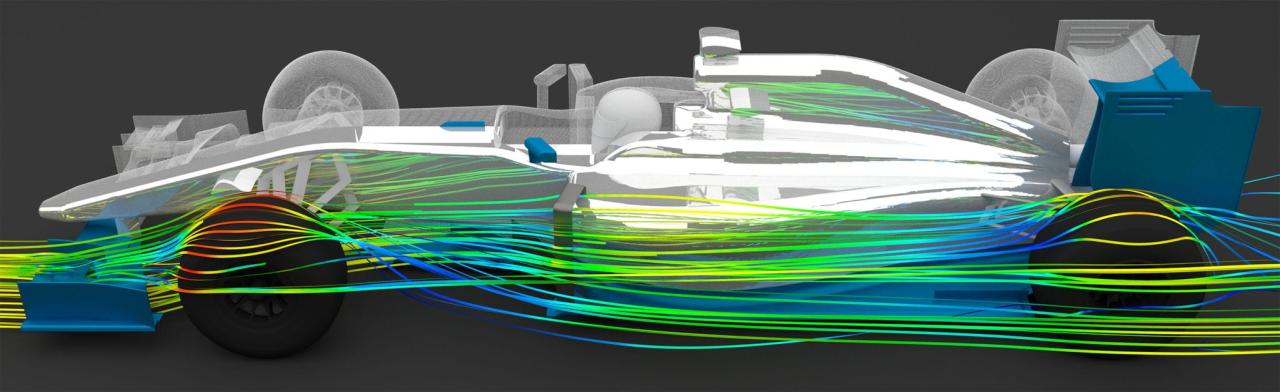
Historically, aerodynamic testing was limited by the availability and astronomical cost of physical wind tunnels. Moreover, FIA regulations strictly limit the amount of time teams can spend in wind tunnels to ensure fair competition. Cloud AI offered a loophole that became a revolution: Computational Fluid Dynamics (CFD).
A. High-Performance Computing (HPC) on Demand
CFD involves simulating the flow of air over the car’s bodywork to maximize downforce and minimize drag. These simulations require solving complex partial differential equations that would take a standard computer decades to process. A. Supercomputing Clusters: Teams now spin up massive HPC clusters in the cloud. Instead of investing millions in building their own supercomputers (CapEx), they rent thousands of cores for a few hours (OpEx) to run intensive simulations. B. Rapid Iteration: This allows aerodynamicists to test thousands of front-wing designs virtually. The AI analyzes the airflow data and automatically suggests design improvements, accelerating the R&D cycle from weeks to hours.
B. The AI Design Loop
Advanced Machine Learning algorithms are now being trained to design parts themselves. A. Generative Design: Engineers set the parameters (e.g., “maximize strength, minimize weight, fit within these dimensions”), and the Cloud AI generates hundreds of potential designs, some of which are organic, skeletal structures that no human would ever conceive. B. Material Science Optimization: The AI also predicts how different materials (carbon fiber weaves) will react under load, ensuring the car is as light as possible without compromising safety.
III. Race Strategy: The Monte Carlo Revolution
Perhaps the most critical application of Cloud AI is in race strategy. The decision to pit for new tires, the choice of tire compound, and the timing of the stop are all determined by probabilistic models running in the cloud.
A. Monte Carlo Simulations
During a Grand Prix, cloud servers run Monte Carlo simulations. This is a mathematical technique that models the probability of different outcomes by running the race millions of times virtually. A. Variable Integration: The AI inputs variables such as tire degradation rates, fuel load, track temperature, weather forecasts, probability of a Safety Car, and the pace of rival cars. B. Live Prediction: As the race unfolds, the simulation updates in real-time. If a rival driver slows down by 0.2 seconds, the AI re-runs millions of simulations instantly to calculate the new optimal strategy.
B. The “Undercut” and “Overcut” Calculation
In F1, an “undercut” is pitting early to get fresh tires and drive faster than the rival ahead, hoping to pass them when they eventually pit. A. The AI Call: Human strategists rely on the AI to tell them the exact lap to pit. The Cloud AI calculates the “Pit Window” with precision down to the tenth of a second, advising the team: “If you pit now, you have a 94% chance of emerging ahead of Ferrari.” B. Traffic Management: The AI also tracks the GPS position of every car on the track to ensure that when a driver exits the pits, they do not come out behind a slower car (traffic), which would ruin their race.
IV. The Edge: Driver Performance and Biometrics
Cloud AI is not just analyzing the machine; it is analyzing the human. The driver is the most variable element in the equation, and AI helps optimize their performance.
A. Telemetry Comparison
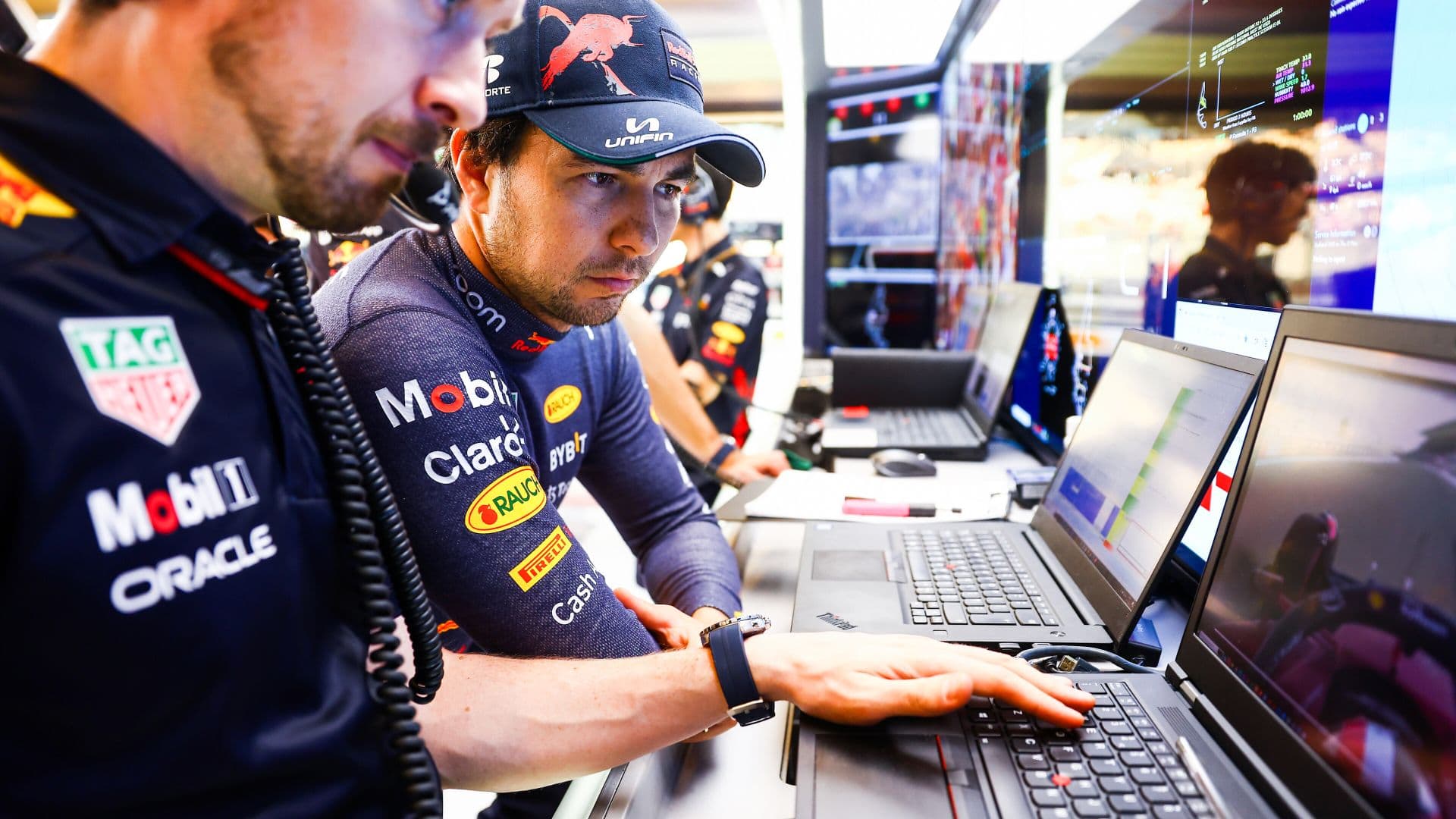
Teams use AI to overlay the telemetry traces of teammates (e.g., Max Verstappen vs. Sergio Perez). A. Cornering Analysis: The system highlights exactly where one driver is braking later or getting on the throttle earlier. B. Ghost Car Visualization: In the simulator, drivers can race against a “ghost” of their teammate’s best lap, allowing them to learn the perfect line through trial and error before arriving at the track.
B. Biometric Feedback
Sensors in the driver’s gloves and suit monitor heart rate, oxygen levels, and body temperature. A. Fatigue Prediction: AI analyzes this biometric data to predict driver fatigue. If a driver’s reaction times are slowing down due to heat exhaustion, the engineer might advise a change in driving style or drink schedule via the radio. B. Accident Analysis: In the event of a crash, the data is instantly uploaded to the cloud to analyze the G-forces the driver experienced, helping medical teams assess potential injuries before the rescue car even arrives.
V. The Cost Cap Era: FinOps in Formula 1
In 2021, F1 introduced a “Cost Cap,” limiting how much teams can spend per season (around $135 million). This fundamentally changed the sport from “who can spend the most” to “who can spend the most efficiently.” This is where Cloud FinOps becomes a competitive advantage.
A. Resource Optimization
Just as businesses use FinOps to control cloud spending, F1 teams use it to control car development spending. A. Budget Allocation: AI models predict the ROI (Return on Investment) of a proposed upgrade. For example, “Will a new front wing design give us enough lap time (0.1 seconds) to justify the $200,000 manufacturing cost?” B. Inventory Management: Cloud ERP (Enterprise Resource Planning) systems track every bolt and screw. AI predicts consumption rates to ensure teams don’t over-manufacture spare parts that will end up unused (waste), keeping them within the budget cap.
B. Cloud Cost Efficiency
By moving to the cloud, teams also reduce their own IT overhead. A. Pay-as-You-Go: Instead of maintaining expensive on-premise data centers that sit idle between races, teams pay only for the compute power they use during the race weekend. B. Green Engineering: This efficiency also aligns with F1’s goal of becoming Net Zero Carbon by 2030, as cloud providers are increasingly powered by renewable energy.
VI. The Fan Experience: Big Data Visualization
The impact of Cloud AI extends beyond the pit wall to the living rooms of fans. Formula 1 Management (FOM) partners with cloud giants to create “F1 Insights.”
A. Real-Time On-Screen Graphics
Those statistics you see on TV—”Tire Life Remaining,” “Overtake Probability,” “Corner Analysis”—are all generated by Cloud AI models processing live data. A. Predictive Drama: The AI calculates the probability of an overtake, building suspense. For instance, “Verstappen has a 70% chance of overtaking within 3 laps.” B. Sound Analysis: Advanced audio analysis of the engine note can even predict engine failures or transmission issues before they are visible.
B. Personalized Content
Streaming platforms use AI to serve personalized content to fans. A. Highlight Reels: Automated editing algorithms scan hours of race footage to instantly compile highlight reels based on specific drivers or overtaking action. B. Interactive Data: Fans can now access deep-dive telemetry on second screens, democratizing the data that was once exclusive to race engineers.
Conclusion
The romantic era of the “garagista”—where a mechanic with a wrench and a gut feeling could win a championship—is over. Today, Formula 1 is the pinnacle of technological warfare. The teams that dominate the podium, like Red Bull Racing and Mercedes, are the ones that have most effectively harnessed the power of Cloud AI.
This technology has become the “Winning Secret” because it compresses time. It allows teams to fail fast in the virtual world so they can succeed in the physical one. It turns chaos into calculated probability. It transforms raw data into a competitive strategy.
For the modern enterprise, the lesson from F1 is clear: In a data-driven world, the winner is not necessarily the strongest or the fastest, but the most intelligent. Cloud AI is the engine of that intelligence. As we look to the future, with autonomous systems and quantum computing on the horizon, the marriage between speed and silicon will only deepen. In Formula 1, as in business, if you are not in the cloud, you are already behind the Safety Car.